


BLW and Daycare: What to Do When You're Back at Work
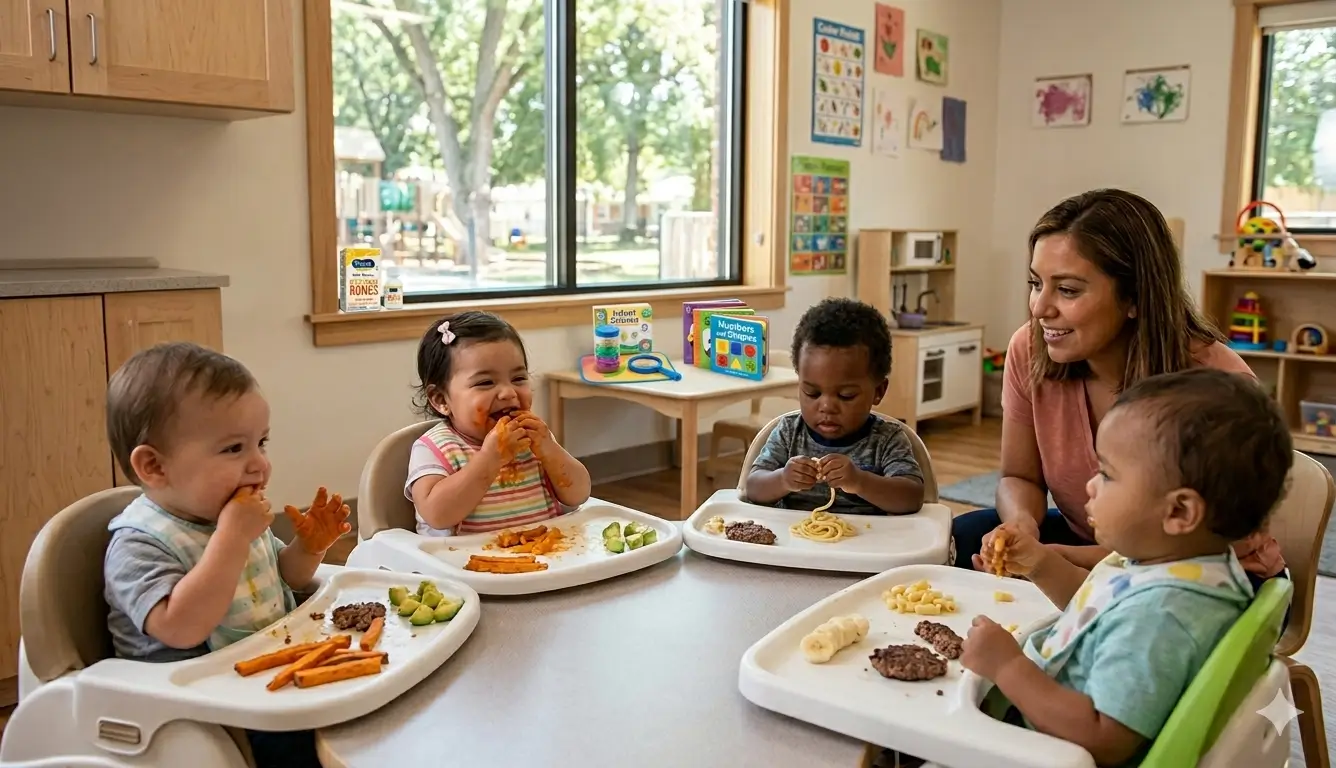
You start thinking about solids. You're excited - you've read about BLW, you like the idea, and then you realize something slightly inconvenient: your baby is going to be in daycare when it happens.
And suddenly the question isn't just "how do I start baby-led weaning?" It's "what if my daycare won't do it?"
Maybe they've already mentioned they only do purees. Maybe you haven't asked yet but you're already bracing for the conversation. Maybe you're worried that the whole thing falls apart if you're not there for most meals.
It doesn't. You're not the only one trying to figure this out - and it's more workable than it looks.
First: you can still do this
Even if daycare only offers purees. Even if you're not there for lunch. Even if mealtimes at home and mealtimes at daycare look completely different from each other.
BLW doesn't have to happen at every single meal to work. Your baby can self-feed at breakfast and dinner, explore food on weekends, and have a totally different experience during the day - and still develop all the same skills. This is how a lot of US families actually do it, even if nobody's making reels about it.
Why this feels harder than the books suggest
Most BLW content was written with a parent-at-home setup in mind. In the US, many parents are back at work by eight or ten weeks, which means by the time solids start at six months, daycare has been running the show for months already.
So you're not doing anything wrong. Your situation is just different from the one most BLW guides picture - and that means you need a slightly different approach.
Have the conversation before you need it
The single most useful thing you can do is bring this up with your daycare provider before solids start, not after.
When you do, don't lead with "we're planning to do baby-led weaning." Lead with a question: "We're starting solids soon - what's your approach for babies this age?" That keeps it open. It gives you information. And it's much less likely to feel confrontational than announcing a feeding method they may not have heard of.
What you want to find out: whether they're open to soft finger foods, what their safety policies look like, whether they have allergy restrictions in the room, and what you're allowed to send from home. Once you know that, you can figure out what's actually possible.
If they say they only do purees
This is really common, and it's not the disaster it feels like. Here's the thing: at six months, babies typically only need one solid meal a day. If that meal happens at home - before drop-off or after pickup - then daycare's approach to food is largely irrelevant for now.
You do BLW at home. Daycare does whatever they're comfortable with. That's not a compromise - that's just how it works for a lot of families.
As your baby gets older and moves toward two or three meals a day, the daycare piece matters more. But by seven, eight, nine months, many providers naturally become more comfortable with finger foods because developmentally it makes sense - babies that age want to self-feed, and providers see it happen. A conversation that felt impossible at six months often gets much easier a few months later.
What most families actually end up doing
A mix. Breakfast or dinner at home, BLW-style. Whatever daycare is comfortable with during the day. Weekends with more time and less pressure. It's not perfect, but it works - and more importantly, it's sustainable.
If this is where you land, don't spend energy feeling like you're doing it wrong. Your baby is eating, exploring food, and learning. That's what matters.
A middle ground that works better than it sounds
Even providers who say "we only do purees" are often more flexible than that initial conversation suggests, once they understand what you're actually asking.
Soft, pre-cut food that just needs to go on a tray isn't more work than a jar of puree - it might actually be less. The pushback usually isn't really about the food; it's about unfamiliarity and the safety concern that comes with it. Address that, and things often open up.
If you're sending food from home, keep it simple and familiar. Think things you can prep in a few minutes the night before - a bit of pasta, scrambled egg, chopped fruit in a small container. Our guide to best first foods has more on what works well in these early weeks if you're putting together a starting list.
One thing worth having in your back pocket: the preloaded spoon. You load the spoon with yogurt or oatmeal or pureed sweet potato, and hand it to your baby - they bring it to their mouth themselves. To a daycare provider, it looks like standard spoon-feeding - but your baby is still in control. It's a useful bridge when you're working with a provider who isn't fully on board but isn't saying a hard no either.
The choking question (this is usually what's really going on)
When a daycare provider pushes back on finger foods, the real concern underneath it is almost always choking. They're watching multiple babies at once. They may not know the difference between gagging and choking. They're not going to take risks with a child in their care.
That's understandable, and worth treating as such rather than as an obstacle to argue against.
What actually helps is being specific about what you're sending and why it's safe - soft enough to squash, cut appropriately, nothing round or hard. You're not asking them to manage a choking risk. You're asking them to put some soft banana pieces on a tray. Framed that way, most providers are more open than the initial "we only do purees" suggests.
If it helps, our guide to gagging vs. choking explains the difference clearly - it's the kind of thing you could share with a provider if the conversation calls for it.
One rule that isn't negotiable: allergens at home only
Whatever you work out with daycare, keep this one firm: any food your baby hasn't tried before stays at home until you've introduced it yourself, watched for a reaction, and know it's fine.
Daycare is not the place to find out your baby is allergic to eggs. Or peanut butter. Or anything else on the top-nine list. New allergens happen at home, during the day, when you're there and paying attention. Our guide to introducing allergens walks through the how and when of all of that.
When BLW mostly happens at home
For some families - especially those with long daycare hours, inflexible providers, or just a lot going on - BLW ends up being primarily a home thing. Dinner, weekends, the occasional slow morning.
That's fine. A baby who self-feeds at dinner and on Saturdays is still learning to chew, still developing hand-to-mouth coordination, still figuring out flavors and textures and how hungry they actually are. None of that is lost because lunch was a pouch at daycare.
If you're just getting started and want a sense of what those home sessions actually look like, how to start baby-led weaning walks you through day one without making it into more than it needs to be.
What actually matters here
The goal was never to do BLW at every meal in every setting. The goal is a baby who gradually learns to eat, who has a healthy relationship with food, and who doesn't have a parent running themselves ragged trying to achieve textbook feeding in a situation that doesn't look like the textbook.
Purees at daycare, finger foods at home - that's not failing at BLW. That's just parenting in the real world, with the actual constraints you actually have. Most of the families who end up with adventurous, capable eaters got there exactly this way. That's not a workaround - that's what this actually looks like for most people.