


Does My Baby Still Need Vitamin D and Iron Drops When Starting Solids?
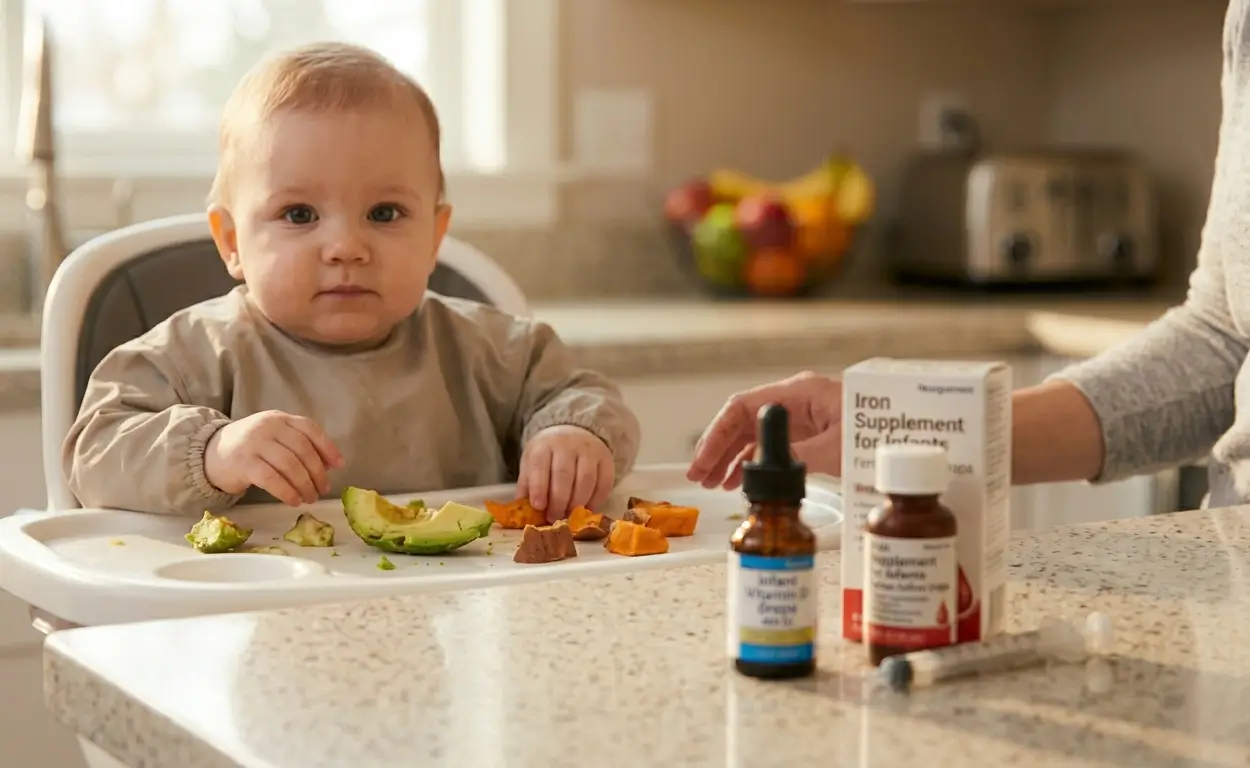
Your pediatrician mentioned vitamin D drops at the two-week visit. Then iron came up at some point - maybe at the four-month appointment, maybe in a handout you half-read at 11pm. You've been giving them (more or less consistently), and now your baby is starting solids and you're wondering: is any of this still necessary?
It's one of those questions that should have a simple answer and somehow doesn't. So let's just go through it.
The short version
Vitamin D drops usually continue throughout breastfeeding. Food doesn't really replace them.
Iron drops continue until your baby is genuinely eating enough iron-rich food - not just tasting it, actually eating it. For most babies doing BLW, that's somewhere around eight to ten months, not six.
If you're formula feeding, you're probably covered on both - formula is fortified. If you're doing a mix of breast milk and formula, it depends on how much of each. More on that in a moment.
Why two separate nutrients need separate thinking
Breast milk is amazing - but there are two nutrients where babies often need extra help, and they work differently.
Vitamin D simply isn't present in breast milk in useful amounts. It's not a quality issue with your milk - it's just how human milk is made. Babies can technically get vitamin D from sun exposure, but the AAP recommends keeping infant skin protected from direct sun, which means that route isn't reliable either. So unless your baby is drinking more than about 28 ounces of formula a day, drops are the practical solution. The recommendation is 400 IU daily from the first few days of life.
Iron is different. Babies are born with iron stores built up during pregnancy, and those stores are usually enough for the first four to six months. After that, they start running low - which is why iron drops typically come into the picture around four months for breastfed babies, not at birth. Breast milk does contain iron, but not enough to keep up with a growing baby's needs once those stores dip.
This is where most parents stop the iron drops too early
The assumption a lot of parents make - understandably - is that once solids start at six months, food takes over. Job done, drops retired.
But a six-month-old who just started BLW isn't really eating yet. They're exploring. They're picking things up, squishing them, getting small amounts in their mouths, and occasionally swallowing something. It's important and it's wonderful, but it's not nutritionally significant. Not yet.
Iron from food takes time to replace what the drops were doing. It's a gradual handover - not an overnight switch. If you stop the drops the week your baby has their first taste of banana, there's a gap. And iron deficiency is worth avoiding - it affects energy, development, and brain growth in ways that can be hard to spot in the moment.
You haven't done anything wrong if you've already stopped. This catches a lot of people out. But if your baby is six or seven months old and not yet consistently eating iron-rich foods in real amounts, it's worth restarting. There's no harm in continuing drops a bit longer.
So when is it actually okay to stop?
When your baby is genuinely eating iron-rich foods most days and swallowing meaningful amounts - not just tasting them. That usually happens somewhere between eight and ten months, but it genuinely varies. Some babies are enthusiastic eaters from the start. Others take longer to get there, and that's normal too.
The practical signs:
- your baby is eating iron-rich foods at most meals
- they're actually swallowing rather than mostly exploring
- this has been consistent over a few weeks, not just one good day
The good iron sources to focus on are eggs, soft shredded chicken or beef, lentils, beans, and iron-fortified oatmeal. If you're not sure where to start, our guide to best first foods goes into more detail on what works well in these early weeks.
One thing worth knowing: iron from plant sources - lentils, beans, spinach - is a bit harder for the body to absorb than iron from meat. You can help with this by pairing those foods with something vitamin C-rich in the same meal. Lentils with a bit of tomato. Oatmeal with some strawberry. Beans alongside a few pieces of orange. It doesn't have to be complicated.
A word on iron-fortified cereal
Iron-fortified infant oatmeal gets a bit overlooked in BLW circles because it's associated with spoon-feeding, but it's actually one of the most concentrated iron sources available for babies and works well in a BLW approach. You can make it thicker than the packet suggests and serve it on a preloaded spoon for your baby to bring to their own mouth, or use it to make soft pancakes or small baked puffs.
If you're going to use infant cereal, go for oat or multigrain rather than rice. The FDA has raised concerns about arsenic levels in rice-based infant products, and oat cereal provides the same iron benefit without that issue.
Vitamin D: this one doesn't really have a food solution
Unlike iron, there isn't a realistic way to get enough vitamin D through baby food at this age. Even when your baby is eating well, the amounts in solid food aren't enough to replace the drops.
If you're breastfeeding, keep giving vitamin D drops - even once your baby is eating well. It continues until breastfeeding ends and your baby is drinking vitamin D-fortified milk in adequate amounts - not before.
This is the one that catches people out most often. It feels like something you'd only do for a newborn. In practice, it goes on much longer than most parents expect.
Formula and combination feeding
If your baby is exclusively formula-fed on standard iron-fortified formula, you most likely don't need additional iron or vitamin D supplements - formula is designed to cover both. Check with your pediatrician if you're unsure about your specific formula.
If you're combination feeding - some breast milk, some formula - the picture depends on the balance. As a rough guide:
- mostly formula - needs are probably covered
- mostly breast milk with formula as a top-up - treat it more like exclusive breastfeeding and keep giving the drops
If you're not sure, ask at your next well-child visit. It's genuinely a common question and a quick one to answer with your specific situation in front of you.
The twelve-month check
Most babies have a blood test at their one-year well-child visit that checks for iron deficiency. Think of it as a safety net - it's there specifically so that if anything has slipped through, it can be caught and corrected easily. Iron deficiency at this age is treatable with a short course of drops.
You don't need to get the timing of all this perfectly right. Continuing drops a bit longer than necessary does no harm. The twelve-month screen exists precisely because this transition is imprecise and that's okay.
If you're just getting started with solids and want to make sure you're offering the right foods from the beginning, our guide to how to start baby-led weaning walks through what those first sessions actually look like. And if allergens are on your mind - eggs are one of the best early iron sources and also one of the top nine allergens - our guide to introducing allergens covers how to approach that.
The honest summary
Give vitamin D drops throughout breastfeeding. Food doesn't replace them.
Keep iron drops going until your baby is consistently eating iron-rich foods in real amounts - which for most BLW babies is closer to eight or nine months than six.
If you've stopped early, restart. If you're unsure, continue a bit longer. The twelve-month iron screen is your backstop.
And if your baby has spent the last month mainly using steamed carrot sticks as drumsticks rather than eating them - that's normal, and the drops are still doing their job in the meantime. You're not behind - this is exactly how it usually goes.