

What Is Baby-Led Weaning And Is It Right for You and Your Baby?
You've heard the term. Maybe a friend mentioned it, or you heard about it at a baby group, or you fell down a rabbit hole online at 2am while scrolling, wondering if it's actually a thing. It sounds appealing: no pureeing, no separate baby meals, your little one just… eats food. But then the questions start - is this a new thing? Is it safe? What exactly do you actually give them? Then the worst fear, what if they choke?
If that's where you are right now in your baby's life, you're in exactly the right place. We'll walk you through what baby-led weaning is, how it works, and what to expect, without making it more complicated than it needs to be. Because we all know you already have your hands full.
So what actually is baby-led weaning?
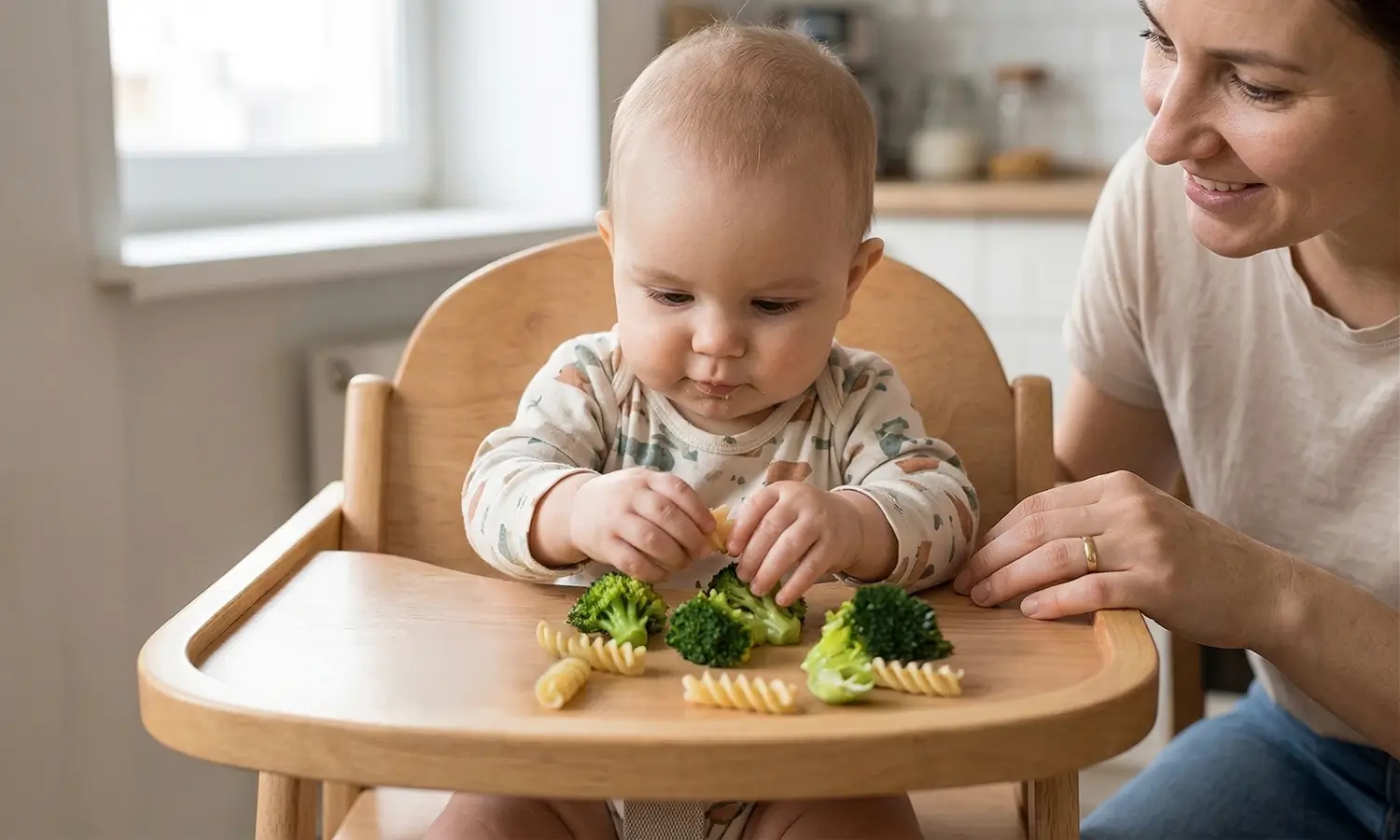
The idea is straightforward. Instead of pureeing food and spoon-feeding your baby, you start by offering soft pieces of real food and let them feed themselves. They sit with you at mealtimes, learn how to pick things up, have a good explore of taste and smell, and gradually work out how to eat themselves. No steaming and blending, no separate baby meals, no being three steps ahead with a freezer full of ice cube portions.
The "weaning" part just means transitioning away from an entirely milk-based diet. It doesn't mean stopping breastfeeding or formula. Solid food is introduced alongside milk, which is still doing most of the nutritional heavy lifting for quite a while yet.
Baby-led weaning caught on partly because it fits naturally into family life, and partly because it tends to help babies build a healthier relationship with food from early on. They learn to read their own hunger cues, get used to all sorts of tastes and textures, and eat because they want to, not because someone's guiding a spoon towards their mouth, thereby minimising mealtime upsets and frustration for both of you.
Is it safe?
This is the question that holds a lot of parents back from trying BLW, and honestly, it's the biggest worry, and a fair one too. With some basic common sense, baby-led weaning is safe.
The main worry for most people is of course choking, but there's a distinction worth getting your head around first: gagging is not choking. Gagging is incredibly common when babies start solids. It looks alarming, but it's a protective reflex that moves food forward and away from the airway. Choking, where the airway is genuinely blocked, is much rarer. We cover all of this properly in an article on gagging vs choking, which is well worth a read before you start.
When should you start?
Around six months is the right sort of time for most babies, but the age matters less than whether your baby is actually ready. There are a few signs to look out for: sitting upright with minimal support, being able to bring things to their mouth, and having lost the tongue-thrust reflex that makes very young babies push everything straight back out. When those things come together, you're good to go.
If you're trying to work out whether your baby's quite there yet, or fending off comments from well-meaning relatives, our guide to when to start weaning covers all of this and will help you feel a lot more confident.
How do you actually start?
Much more simply than you'd think. The first session is just one or two soft foods, your baby in a high chair, and about ten minutes of letting them have a play. A bib, something to wipe the inevitable mess, and a safe place to sit is your starting point.
In the early days, most babies don't eat much at all. They mostly squish things, drop them, and stare at them curiously. That's completely fine, because at this stage food is about exploring, not nutrition. Milk is still covering all of that. The day-one walkthrough walks you through what day one actually looks like, what to expect in the first week, and how to build from there without tying yourself in knots about it. It can actually be a lot of fun for both you and your baby, discovering food is a wonderful milestone to experience.
What should you give them?
Start simple. Ripe banana cut into fingers, steamed carrot sticks, soft broccoli florets, avocado, scrambled egg, toast with a thin spread. All brilliant starting points because they're soft, easy for little hands to grip, and no fuss to prepare. Just things that are soft enough to squash between your fingers and big enough not to get lost in a small fist. If you'd like a ready-made list to keep on the fridge, our weaning chart pulls it all together.
One thing worth introducing fairly early on is iron-rich food. Babies' iron stores start to dip at around six months, so getting eggs, soft chicken, lentils, or fortified porridge in regularly from the start is a good habit. This breakdown of best first foods has loads of practical ideas and covers what works well and what's better left a bit longer.
What about allergens?
Another valid concern: introducing things like peanuts, eggs, and dairy when there's a worry about potential reactions. The guidance has actually shifted quite a lot though. Introducing allergens early is now recommended rather than avoided, because the evidence suggests it can help reduce the risk of allergies developing. It is recommended to do it carefully, one at a time, in a small amount, at home during the day. The guide to introducing allergens talks you through it and explains what a real allergic reaction looks like, as opposed to normal gagging or a screwed-up face, which are very different things.
Do you have to choose between baby-led weaning and purees?
No, and it's worth saying clearly because it causes a lot of unnecessary stress. Baby-led weaning and spoon-feeding aren't two opposing camps. Plenty of families do a mix: finger foods at some meals, spoon-fed porridge or yogurt at others. There's no rule that says you have to commit to one approach and stick with it.
The goal is to help your baby learn to eat in a way that works for your family. If that includes a bit of both, that's absolutely fine, as long as you're both happy and enjoying the process. Don't forget, they'll grow up and be eating independently just fine in time!
What if my baby just won't eat?
Almost every parent goes through a patch of this, and almost all of them worry it means something's wrong. It usually doesn't. Some babies take weeks to show any real interest in food, and plenty have whole high chair sessions where nothing gets eaten at all. Phases of enthusiasm followed by apparent backtracking are also completely normal. None of it means you're doing something wrong, or that your baby won't eventually crack it. Milk is still the main event nutritionally, so nothing's falling through the cracks.
If you're dutifully preparing food that ends up entirely on the floor while you try not to take it personally, this info on food refusal will probably help.
The most important thing
Baby-led weaning can feel like a big deal before you start: lots of questions, a lot of mess on the horizon, a lot of wondering if you're doing it right. In practice, it tends to settle once you're actually in it. You offer food. Your baby explores it. You wipe everything down. You do it again tomorrow.
Start simple, follow your baby's lead, and give yourself permission to learn as you go. Most parents look back on those early weeks and realise they were far more worried than they needed to be. Try and enjoy it, easier said than done, we know.